From the journal
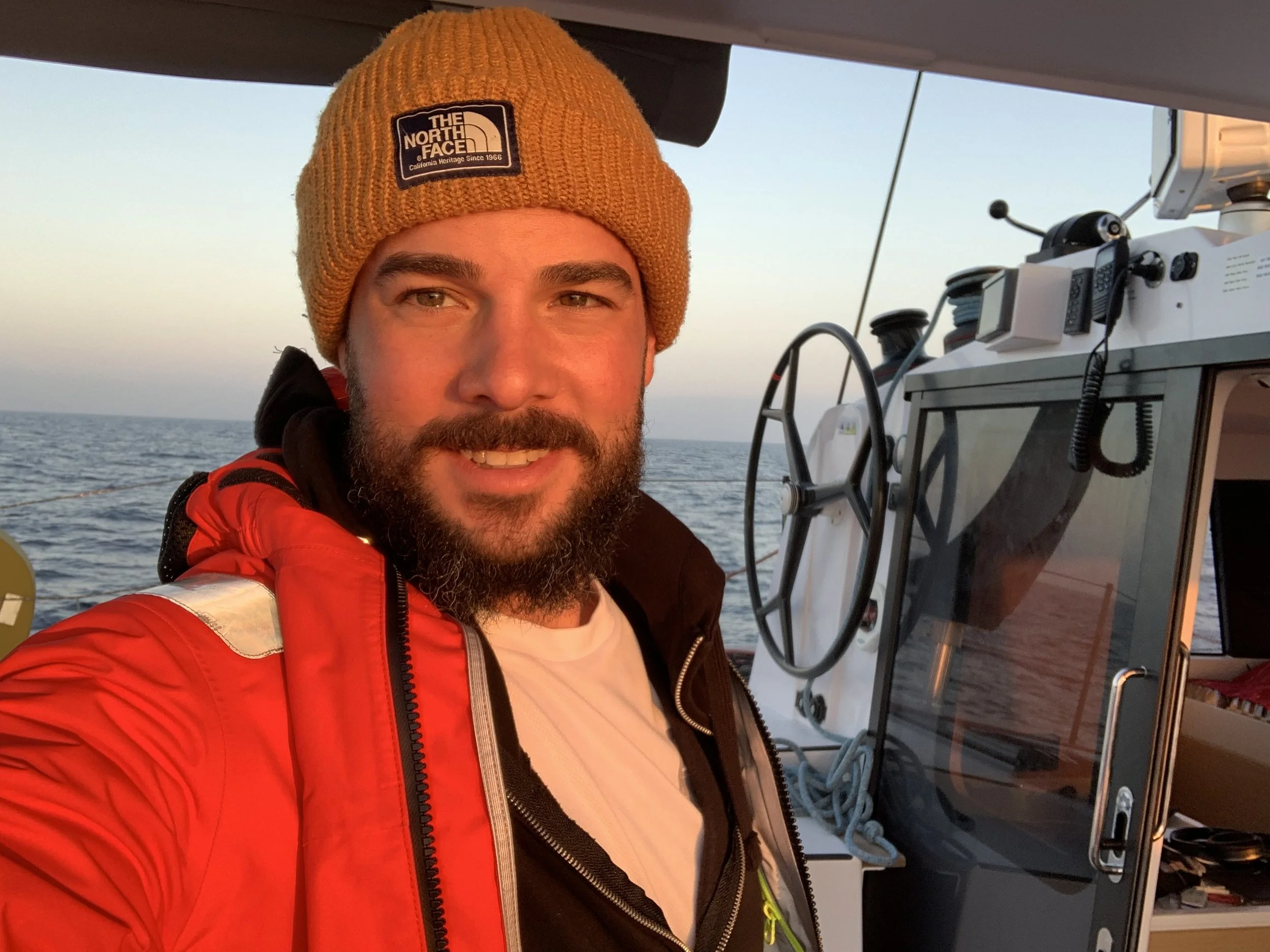
Mid-Atlantic Crossing
02–23–20
For the last few days, I’ve been spending long hours at the helm. On the Transpac, I never quite learned how to get the boat to surf downwind consistently. I was always late to the moment, chasing speed just after it had already passed, burying the bows, stressing the rig. So on this crossing, I made a quiet pact with myself: steer every day, for hours if needed, and listen.
At first, I almost had it. Enough to feel the promise, not enough to hold it. Then another crew member would take over the helm after my five hours and make it look effortless. He had more time on catamarans than I did, and the ocean has a way of revealing experience without cruelty. No judgment. Just truth.
So I stayed with it.
There is something deeply meditative about standing at the helm with music in your ears and miles of water ahead. The world narrows to wind angle, wave shape, pressure through your hands. I found myself smiling without realizing it. Today, something finally clicked. I learned how to read the waves early enough to meet them instead of react to them. The boat began to surf, cleanly and consistently. It felt glorious, not because it was fast, but because it was right.
Out here, roles dissolve. I’ve realized that my agility, strength, and speed matter on a small crew. I am not just a chef or a cameraman. I am a crew member. A body in motion. A hand ready to move before the mind finishes its sentence. My intuition on sail changes and adjustments has been surprisingly accurate. There’s a kind of knowing that only shows up when you are fully present.
Reflection
I wish I had been more disciplined with this journal. Writing feels like steering. You don’t notice its importance until you drift. Moving forward, I want to treat it with the respect it deserves.
As I pull further away from social media, I’m beginning to understand that I don’t need it. What I actually miss are moments like this. The quiet dialogue between myself and the natural world. The ocean does not perform. It does not ask for attention. It simply exists, and in doing so, invites you back into yourself.
Recently, I worked at the Consumer Electronics Show. By coincidence or cosmic irony, I helped Bloomberg News interview Jensen Huang, the CEO of NVIDIA, one of the most influential figures shaping the future of artificial intelligence. I stood maybe five feet away from him. I doubt he noticed I was there. It was strange to watch two universes overlap without ever truly touching.
Walking the floor at CES afterward, the only thing that genuinely caught my curiosity was an antigravity drone. A 360-degree flying camera. Another tool for the quiver. But overall, the event felt like a sprint to sell convenience dressed up as progress. Devices promising escape without ever offering freedom.
For me, real escape isn’t found in technology. It’s found in subtraction. Fewer inputs. Fewer notifications. Fewer reasons to look away from what’s directly in front of me.
As the world heats up in more ways than one, I feel a growing desire to sail farther from the noise. To let all of this become a distant murmur on the horizon. I worry about the dystopia we seem to be building so enthusiastically.
Wind.
Water.
Motion.
Presence.
Everything else can wait.